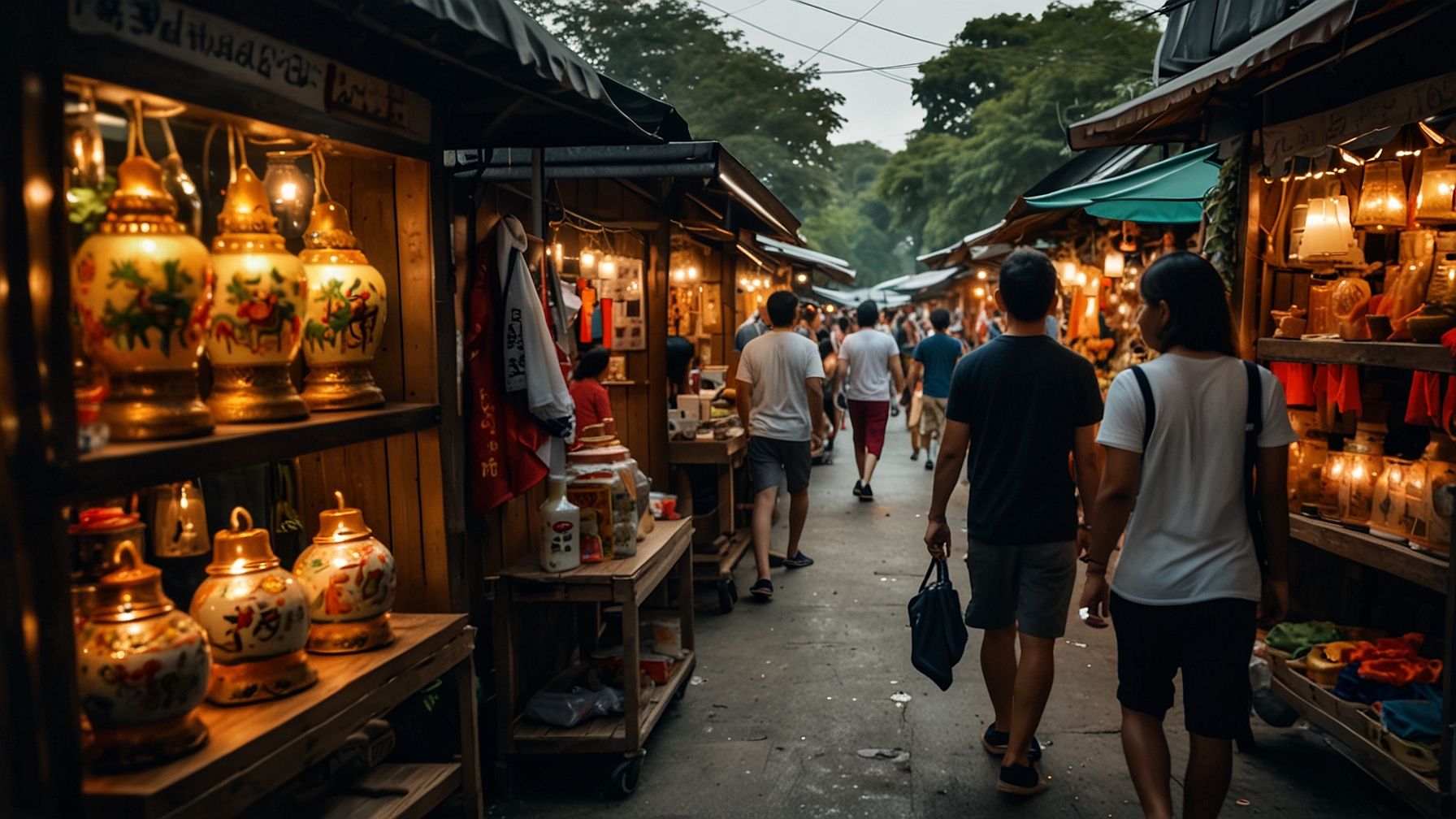

The energy of a Thai market — stalls stacked with fresh produce, handmade crafts, street food sizzling a few feet away — is one of the best reasons to slow down and wander on a trip to Thailand. Bargaining is part of that experience, but it works differently depending on where you are and what you're buying. Here's how to actually do it well.
⚡ Quick answer
Look for a printed price tag or sign — if there is one, the price is fixed. No tag, especially at souvenir and clothing stalls, usually means there's room to negotiate. Food stalls run on thin margins and are rarely worth bargaining over.
Understanding Thai Markets
Thai markets aren't one uniform thing — how you shop depends heavily on which type you're in. Knowing the difference upfront saves you from either overpaying or accidentally offending a vendor with a low-ball offer that doesn't fit the setting.
- ✅ Floating Markets: Canal-based and highly scenic, but many popular ones (like Damnoen Saduak and Amphawa) are now heavily tourist-oriented. Food sold from the boats tends to run near-fixed pricing; the negotiating room is mostly in the souvenir stalls on the banks.
- 📍 Night Markets: A mix of food, souvenirs, and clothing. Clothing and craft stalls usually have flexibility; food stalls generally don't.
- 💡 Local/Fresh Markets: Aimed at residents, not tourists. Prices on produce and daily goods are already thin-margin and close to fixed — this is not the place for aggressive bargaining.
The Art of Bargaining
Prices at souvenir and craft stalls are rarely fixed, and negotiating there is completely normal — vendors expect it and often price with room built in. The skill is knowing where that applies and where it doesn't.
Spot the fixed-price signal first
A visible printed price tag or sign is the clearest cue you'll get: it means the price is set, and bargaining there tends to land awkwardly. No tag — common at souvenir and craft stalls — is your signal that a bit of back-and-forth is welcome.
- ✅ Check a few stalls selling the same item to get a baseline before you commit to a number.
- 📍 Carry small bills — markets are cash-heavy, vendors often can't break large notes, and exact change makes closing a deal easier for both sides.
💡 Tip: At souvenir and clothing stalls, opening around half the asking price is a reasonable starting point. At food stalls or local markets, skip this entirely — the margins are too thin, and it tends to land as rude rather than savvy.
Building rapport
Thai vendors respond well to friendliness. Open with a smile and a simple "Sawasdee" (hello) — it sets a warmer tone before you've said a word about price.
- ✅ Compliment their products genuinely.
- 📍 A little small talk goes further than a hard opening number.
💡 Tip: Genuine interest in a vendor's craft — asking how something's made, where it's from — often does more to soften a price than the negotiation itself.
Negotiation Strategies
Patience is key
Rushing tends to produce worse deals. Take your time, and don't be afraid to let a price sit unanswered for a moment — at souvenir stalls specifically, that pause does more work than a counter-offer.
Use body language wisely
Stay friendly but composed. Visible excitement over an item tends to firm up a price rather than soften it, so keep your reaction low-key until you've landed on a number.
⚠️ Keep it respectful. Aggressive bargaining, or pushing hard on a vendor's already thin margin — especially at food or local markets — reads as disrespectful of their livelihood, not as savvy shopping.
When to Walk Away
If a vendor won't meet you partway on a souvenir or craft item, walking away is a legitimate move — it sometimes prompts a better offer. A couple of practical checks before you do:
- ✅ The price is genuinely well above your budget, not just above your opening offer.
- 📍 The vendor seems entirely uninterested in negotiating — pushing further won't help.
Conclusion
Bargaining at Thai markets is genuinely part of the experience — but reading the setting matters more than any fixed formula. Watch for price tags, save the negotiating for souvenirs and crafts rather than food, and lead with friendliness over a hard opening number. Do that, and you'll get fair prices without the awkwardness.
FAQs
Is bargaining customary in Thai markets?
Yes, at souvenir, clothing, and craft stalls in particular. It's less appropriate at food stalls and local/fresh markets, where margins are already thin and prices are close to fixed.
How much should I offer when bargaining?
At souvenir and clothing stalls, starting around half the asking price is a reasonable opener, leaving room to meet in the middle. This doesn't apply to food or local markets, where prices are already close to fair.
What should I avoid saying while bargaining?
Skip any comment that criticizes the product or the vendor's culture. Keep it light and respectful — a negotiation, not a complaint.
Are there specific times when bargaining is not appropriate?
Yes — formal shops, supermarkets, and any stall with a visible printed price tag. Also generally skip it at food stalls, even in markets, since margins there are thin.
Disclaimer
The information provided on bangkokairportride.com ("the Site," "we," "us," or "our") is for general informational purposes only. All information on the Site is provided in good faith; however, we make no representation or warranty of any kind, express or implied, regarding the accuracy, adequacy, validity, reliability, availability, or completeness of any information on the Site.
No Professional Advice
The content on this Site does not constitute travel, legal, or financial advice. Any reliance you place on such information is strictly at your own risk. Before making travel arrangements, we recommend verifying details such as flight schedules, visa requirements, and airport procedures directly with the relevant official sources.
Third-Party Links and Services
Our Site may contain links to third-party websites or services that are not owned or controlled by us, including booking platforms, payment processors, or partner transportation providers. We have no control over, and assume no responsibility for, the content, privacy policies, or practices of any third-party websites or services. We do not warrant the offerings of any of these entities/individuals or their websites.
Pricing and Availability
Prices, availability, and service details displayed on the Site are subject to change without notice. While we strive to keep this information accurate and up to date, we do not guarantee that all pricing, schedules, or vehicle availability shown on the Site are current at the time of viewing. Please confirm final details at the time of booking.
Limitation of Liability
Under no circumstance shall we have any liability to you for any loss or damage of any kind incurred as a result of the use of the Site or reliance on any information provided on the Site. Your use of the Site and your reliance on any information on the Site is solely at your own risk. This includes, but is not limited to, delays, missed flights, cancellations, or other travel disruptions arising from circumstances beyond our reasonable control.
External Factors
We are not responsible for delays or service disruptions caused by factors outside our control, including but not limited to traffic conditions, weather, flight delays, road closures, or force majeure events.
Changes to This Disclaimer
We reserve the right to make changes to this disclaimer at any time and for any reason. We encourage users to review this disclaimer periodically for any updates. Your continued use of the Site following any changes constitutes acceptance of those changes.