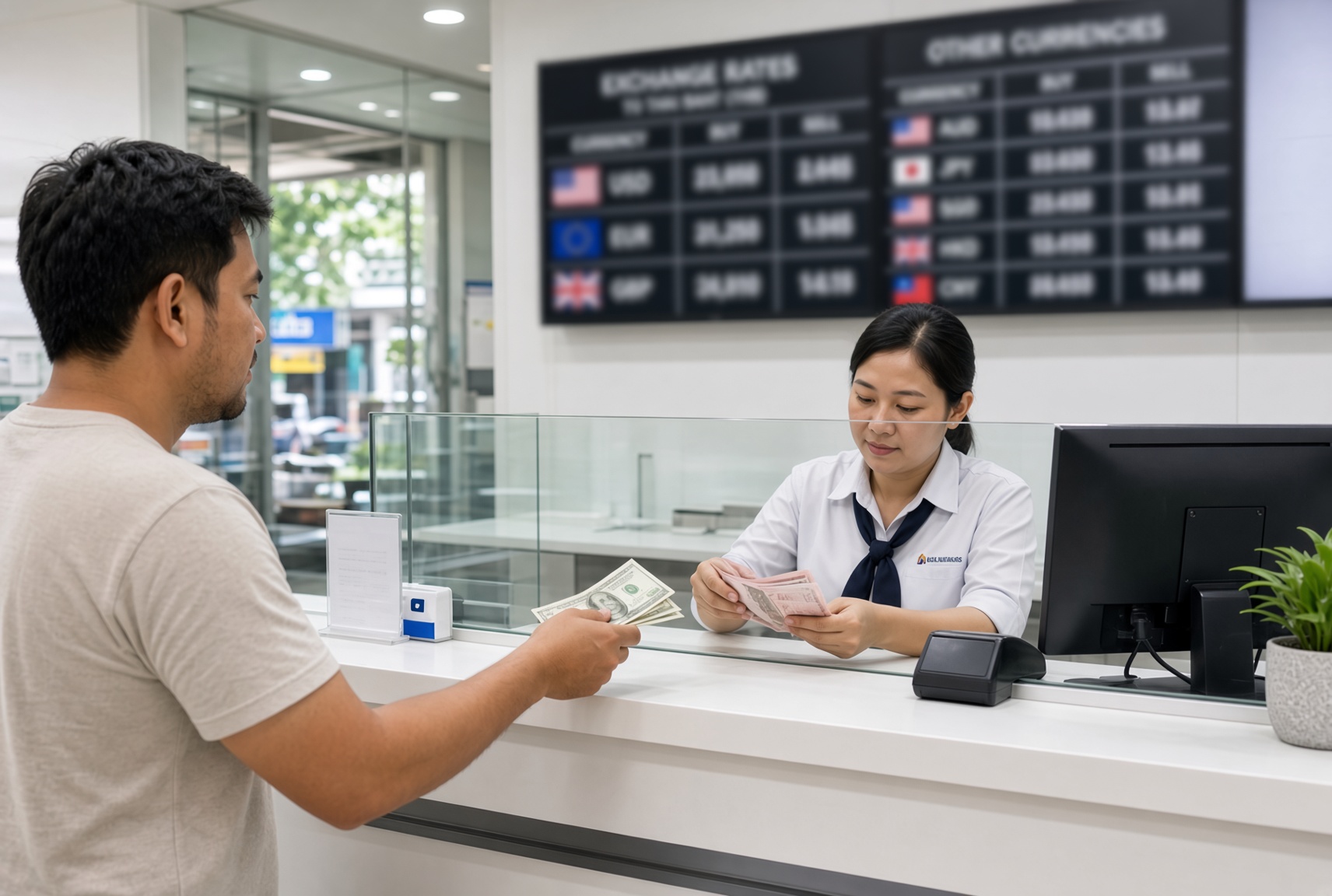

Money logistics shouldn't eat into your trip planning, but a little prep goes a long way in Thailand. Here's exactly how the Baht works, where to actually get a fair exchange rate, and which payment methods will and won't work once you're there.
⚡ Quick answer
ATMs and local banks give the fairest exchange rates; airport and hotel counters cost more but are fine for small immediate amounts. Carry cash for markets and street food, and budget for a flat ~220 THB foreign-card ATM fee on top of whatever your home bank charges.
Understanding the Thai Baht
Thailand's currency is the Thai Baht (THB), subdivided into 100 Satang. Cash is accepted almost everywhere, and card transactions are common in urban areas and tourist spots — but the two aren't interchangeable everywhere, so it pays to know when you'll need which.
💱 Current exchange rates
Rates shift regularly, so check before your trip and again shortly before you exchange. Useful sources include:
- Online currency converters 🌐
- Local banks or currency exchange desks 🏦
- Travel-focused mobile apps 📱
Through 2026, the rate has mostly run in the 31–34 THB per USD range, with the Baht trending slightly weaker over the year — always confirm the live rate before exchanging rather than relying on any fixed figure.
💡 Tip: Round your budgeting up rather than down — exchange rate swings mid-trip can nudge your actual spending higher than a snapshot calculation suggests.
Where to Exchange Currency
Your options each trade off convenience against rate — worth knowing before you're standing at a counter jet-lagged.
Airports and hotels
Convenient, but rates and fees here are consistently the worst of your options. Exchange only a small amount for immediate needs — transport, a snack, incidentals — and handle the rest elsewhere.
Local banks and city exchange counters
Banks and reputable city-center exchange counters generally offer noticeably better rates with lower fees than airport or hotel desks. Bring your passport — it's typically required for any exchange transaction in Thailand.
ATM withdrawals
ATMs are widely available and typically give a competitive underlying exchange rate. The catch: nearly every Thai ATM charges a flat foreign-card withdrawal fee, commonly around 220 THB per transaction — on top of whatever your own bank charges for foreign withdrawals.
⚠️ Withdraw in fewer, larger amounts. With a flat fee applied per transaction, several small withdrawals cost noticeably more over a trip than one or two larger ones — do the math before you tap "withdraw."
Payment Methods in Thailand
Cash
Cash is king in Thailand — especially in street markets, smaller shops, and rural areas. Keep Baht on hand at all times; don't rely on cards outside cities and malls.
Credit and debit cards
Widely accepted at hotels, restaurants, and malls. Some establishments add a surcharge for card payments — always ask before you tap or swipe.
Mobile payment apps
PromptPay — the QR-code payment system linked to Thai bank accounts — is genuinely everywhere, from 7-Eleven to street food carts. TrueMoney Wallet is another widely used option. Both are built around a Thai bank account rather than just a local SIM card, so realistically most short-term tourists will rely on cash and cards rather than setting these up.
💡 Tip: Always ask about card transaction fees abroad — they vary significantly by bank and can quietly add up over a trip.
Tips for Currency Exchange in Thailand
- ✅ Avoid street currency traders. Informal street exchange isn't reliably legitimate and is a common scam setup.
- ✅ Ask about fees upfront at ATMs and exchange counters — a good headline rate can be undercut by hidden charges.
- ✅ Keep small bills on hand. Vendors often can't break large notes, especially at markets.
⚠️ Watch your cash in crowded areas. Pickpocketing does happen at busy markets and transit hubs — keep valuables secure and avoid flashing large amounts of cash.
Conclusion
Managing money in Thailand comes down to a few simple habits: exchange small amounts at the airport and the rest at a bank or ATM, keep cash for markets and street food, and factor in the flat ATM fee so you're not caught off guard. Get that right, and the rest of your budget takes care of itself.
FAQs
What is the best way to exchange money in Thailand?
Local banks and reputable city exchange counters generally offer the best rates and lowest fees. ATMs are convenient and competitive on rate, but carry a flat withdrawal fee — around 220 THB per transaction is typical.
Can I use US dollars in Thailand?
A handful of tourist-facing spots may accept USD, but exchanging for Thai Baht is the better move for nearly every transaction — you'll get a fairer rate and avoid confusion at the register.
Are there fees for using credit cards in Thailand?
Some establishments add a surcharge on card payments — confirm with the vendor before you pay if you're unsure.
Is it safe to withdraw cash from ATMs in Thailand?
Yes — stick to ATMs at bank branches or well-lit, busy areas, and budget for the flat foreign-card fee that's applied on nearly every machine.
Should I inform my bank about my travel plans?
Yes — notifying your bank of your travel dates reduces the chance of a card being flagged and frozen for suspicious activity while you're abroad.
Disclaimer
The information provided on bangkokairportride.com ("the Site," "we," "us," or "our") is for general informational purposes only. All information on the Site is provided in good faith; however, we make no representation or warranty of any kind, express or implied, regarding the accuracy, adequacy, validity, reliability, availability, or completeness of any information on the Site.
No Professional Advice
The content on this Site does not constitute travel, legal, or financial advice. Any reliance you place on such information is strictly at your own risk. Before making travel arrangements, we recommend verifying details such as flight schedules, visa requirements, and airport procedures directly with the relevant official sources.
Third-Party Links and Services
Our Site may contain links to third-party websites or services that are not owned or controlled by us, including booking platforms, payment processors, or partner transportation providers. We have no control over, and assume no responsibility for, the content, privacy policies, or practices of any third-party websites or services. We do not warrant the offerings of any of these entities/individuals or their websites.
Pricing and Availability
Prices, availability, and service details displayed on the Site are subject to change without notice. While we strive to keep this information accurate and up to date, we do not guarantee that all pricing, schedules, or vehicle availability shown on the Site are current at the time of viewing. Please confirm final details at the time of booking.
Limitation of Liability
Under no circumstance shall we have any liability to you for any loss or damage of any kind incurred as a result of the use of the Site or reliance on any information provided on the Site. Your use of the Site and your reliance on any information on the Site is solely at your own risk. This includes, but is not limited to, delays, missed flights, cancellations, or other travel disruptions arising from circumstances beyond our reasonable control.
External Factors
We are not responsible for delays or service disruptions caused by factors outside our control, including but not limited to traffic conditions, weather, flight delays, road closures, or force majeure events.
Changes to This Disclaimer
We reserve the right to make changes to this disclaimer at any time and for any reason. We encourage users to review this disclaimer periodically for any updates. Your continued use of the Site following any changes constitutes acceptance of those changes.