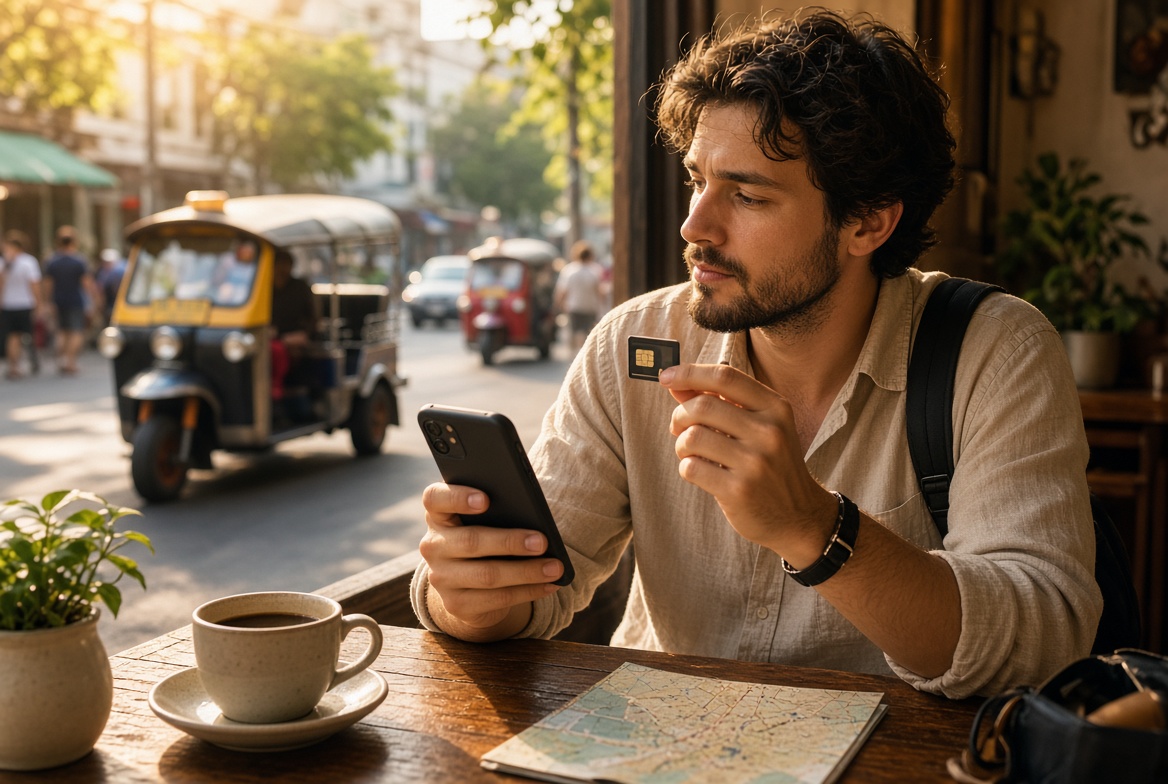

Staying connected in Thailand is genuinely easy — the hard part is just knowing which option actually fits your trip. Here's a clear rundown of prepaid, postpaid, and eSIM options, the providers behind them, and exactly how to get set up as soon as you land.
⚡ Quick answer
Grab a prepaid tourist SIM (or an eSIM, if your phone supports it) at the airport, a mobile shop, or a 7-Eleven — just bring your passport, since registration is required by law. Thailand's market really comes down to two networks now: AIS and True, which absorbed dtac in a 2023 merger.
Understanding Your SIM Options
There are three practical ways to get connected in Thailand, and which one fits depends mostly on your trip length and phone.
📱 Types of SIMs
- ✅ Prepaid physical SIM: The standard tourist choice — buy a set data package, no contract, full control over spending. Typical tourist packages run 8–30 days.
- ✅ eSIM: Increasingly the easiest option for compatible phones — purchase and activate online before you even land, no physical swap or shop visit required.
- ✅ Postpaid SIM: Best for long-term residents or expats, with monthly billing and a contract commitment.
The major networks
Thailand's mobile market is really a two-network story today:
- 📍 AIS: The largest network by coverage, with a slight edge in rural and remote areas, particularly in the north and northeast.
- 📍 True (including the former dtac): DTAC and TrueMove H merged into True Corporation in 2023. You'll still see the dtac name on some plans, but it's now part of the same True network — strong urban and coastal resort coverage.
💡 Tip: Both networks handle Bangkok, Chiang Mai, Phuket, and the main tourist routes well. If your itinerary includes remote islands or mountain areas, it's worth checking coverage maps for your specific route before choosing.
Where to Buy Your SIM Card
Getting set up is easy no matter where you are in the country.
Popular purchase locations
- 📍 Airports: Most international airports have kiosks where you can buy and activate a SIM right on arrival.
- 📍 Mobile phone shops: Widely available in major cities and tourist areas.
- 📍 7-Eleven stores: Convenient for both purchases and top-ups, given how common they are across the country.
Buying online, or going the eSIM route
Many providers let you order a physical SIM online and pick it up at the airport or have it delivered to your hotel. If your phone supports eSIM, you can skip the physical card entirely — purchase and install it before you even leave home, so you land already connected.
💡 Tip: Have your passport ready either way — it's legally required for SIM registration in Thailand, whether you buy in person or online.
Activating Your SIM Card
Activation is quick and usually handled for you at the point of purchase, or via SMS/app instructions.
- Insert the physical SIM, or scan the QR code to install your eSIM.
- Follow the activation instructions provided by the vendor or app.
- Top up with your desired data or call package if it isn't bundled in already.
Tips for Using Your SIM in Thailand
⚠️ Avoid sensitive transactions on public Wi-Fi. Coffee shop and hotel Wi-Fi networks aren't secure — use your mobile data instead for banking, logins, or anything you wouldn't want intercepted.
Data usage and top-ups
Keep an eye on your data usage to avoid running out mid-trip or facing unexpected charges. Top-ups are simple — most convenience stores and every provider's app handle it in a couple of minutes.
Check coverage for your route
Coverage on both major networks is excellent in cities and tourist hubs, and gets patchier at sea, in deep jungle, or on higher mountain passes. If you're heading somewhere remote, it's worth a quick check before you commit to a provider.
Conclusion
Getting connected in Thailand takes minutes, whether you go for a physical SIM on arrival or an eSIM set up before you fly. Bring your passport, pick a network that fits your route, and you'll have reliable data for the rest of the trip.
FAQs
Can I use my existing phone with a Thailand SIM card?
Yes, as long as your phone is unlocked and network-compatible. If your phone supports eSIM, you have the added option of skipping a physical card entirely.
How much data do I need while in Thailand?
Depends on your habits — a package in the 5–10GB range over 8–15 days generally covers light browsing, maps, and messaging. Heavy streaming or hotspotting for a laptop will need more.
Is it expensive to call internationally?
Rates vary by provider and destination — check with them directly, or use a data-based calling app over Wi-Fi or mobile data instead, which is usually far cheaper.
Do I need to register my SIM card?
Yes — Thai law requires registration with your passport, whether you're buying a physical SIM or setting up an eSIM.
What happened to DTAC?
DTAC merged with TrueMove H in 2023 to form True Corporation. The dtac name still appears on some plans, but it now runs on the same network as True — Thailand's market today is essentially AIS versus True.
Disclaimer
The information provided on bangkokairportride.com ("the Site," "we," "us," or "our") is for general informational purposes only. All information on the Site is provided in good faith; however, we make no representation or warranty of any kind, express or implied, regarding the accuracy, adequacy, validity, reliability, availability, or completeness of any information on the Site.
No Professional Advice
The content on this Site does not constitute travel, legal, or financial advice. Any reliance you place on such information is strictly at your own risk. Before making travel arrangements, we recommend verifying details such as flight schedules, visa requirements, and airport procedures directly with the relevant official sources.
Third-Party Links and Services
Our Site may contain links to third-party websites or services that are not owned or controlled by us, including booking platforms, payment processors, or partner transportation providers. We have no control over, and assume no responsibility for, the content, privacy policies, or practices of any third-party websites or services. We do not warrant the offerings of any of these entities/individuals or their websites.
Pricing and Availability
Prices, availability, and service details displayed on the Site are subject to change without notice. While we strive to keep this information accurate and up to date, we do not guarantee that all pricing, schedules, or vehicle availability shown on the Site are current at the time of viewing. Please confirm final details at the time of booking.
Limitation of Liability
Under no circumstance shall we have any liability to you for any loss or damage of any kind incurred as a result of the use of the Site or reliance on any information provided on the Site. Your use of the Site and your reliance on any information on the Site is solely at your own risk. This includes, but is not limited to, delays, missed flights, cancellations, or other travel disruptions arising from circumstances beyond our reasonable control.
External Factors
We are not responsible for delays or service disruptions caused by factors outside our control, including but not limited to traffic conditions, weather, flight delays, road closures, or force majeure events.
Changes to This Disclaimer
We reserve the right to make changes to this disclaimer at any time and for any reason. We encourage users to review this disclaimer periodically for any updates. Your continued use of the Site following any changes constitutes acceptance of those changes.